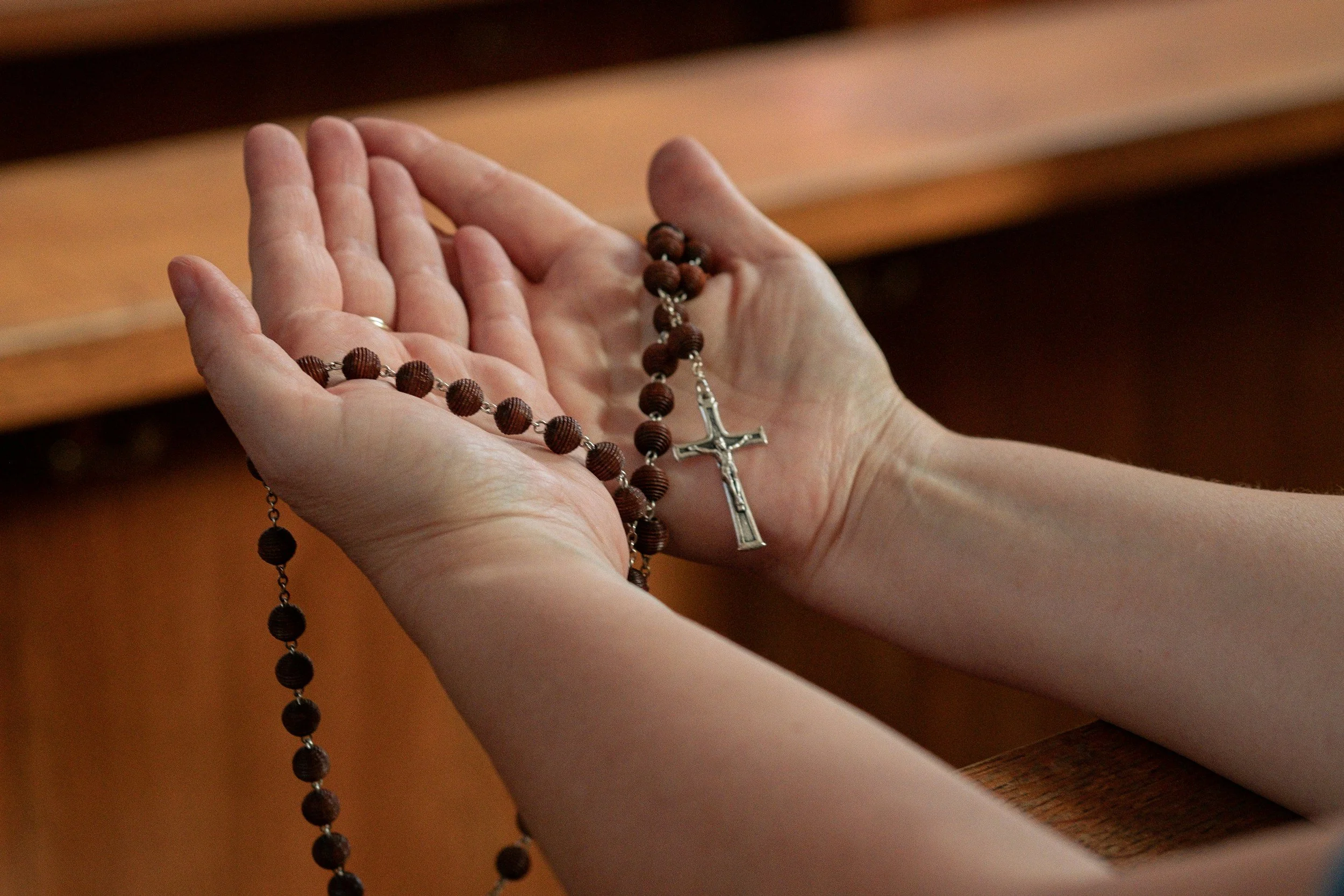
“Deliberately holding the beads can in itself be the prayer.” -
M. Basil Pennington
Praying with Prayer Beads and Prayer Ropes
Praying with beads is one of the most ancient and tactile forms of Christian prayer, a way of letting the body participate alongside the mind and heart. Long before prayer was something silently “thought,” it was often counted, touched, and embodied.
Even the word bead tells this story. It comes from the Old English word bēd, meaning prayer or to pray. Over time, the physical object used to count prayers took on the name of the prayer itself. From their very beginning, beads and prayer have been inseparably linked.
Prayer beads offer rhythm, repetition, and grounding. They can help quiet a racing mind, anchor prayer during times of anxiety or fatigue, and create a gentle structure when words are hard to find. Across Christian history, many traditions have developed their own forms of bead-based prayer, each shaped by theology, culture, and pastoral need.
The Rosary and Related Chaplets
One of the most widely known forms of prayer beads is the Rosary, traditionally associated with Roman Catholic spirituality. The rosary weaves together Scripture, repetition, and meditation on the life of Christ, often through prayers addressed to Mary. While beloved by many, the Marian focus can be difficult for some Protestants or others whose theology is less centered on Marian devotion.
However, several prayers use the traditional rosary structure without that emphasis. A particularly beautiful example is the Chaplet of Divine Mercy. Prayed on a standard Roman Catholic rosary, this chaplet centers on God’s mercy revealed in Christ and is explicitly Christ-focused. For many Christians from a variety of traditions, it provides a powerful, accessible way to engage repetitive prayer without theological discomfort.
The Orthodox Prayer Rope
Another ancient and deeply embodied form of tactile prayer is the Orthodox prayer rope, often made of knotted wool rather than beads. Rooted in the spirituality of the Eastern Church and the Desert Fathers, the prayer rope is traditionally used to pray the Jesus Prayer:
Lord Jesus Christ, Son of God, have mercy on me, a sinner.
This prayer is said once for each knot, allowing the rhythm of breath, touch, and repetition to draw the one praying into stillness and humility. While this form is ancient, it is also remarkably adaptable. Many Christians today use the prayer rope with Scripture verses or short phrases suited to their own theology or season of life.
One adaptation I particularly enjoy praying on a rope or beads is:
Create in me a clean heart, O God, and renew a right spirit within me.
This kind of adaptation stays true to the spirit of the practice while allowing it to meet the pray-er where they are.
The Anglican Rosary
The most recent development in Christian prayer beads is the Anglican rosary, created in the late 20th century. Unlike older forms, the Anglican rosary was intentionally designed to be flexible and ecumenical. Its structure invites creativity rather than prescribing a single set of prayers.
Many people use the Anglican rosary to pray Scripture, seasonal themes, or intentions that change throughout the church year. Others create their own prayers that reflect personal theology, lived experience, or a particular need for healing or discernment. This adaptability makes it especially well-suited for modern spiritual practice and for those who find themselves shaped by multiple Christian traditions.
Prayer Beads in Other Traditions
While Christianity has developed many forms of prayer beads, it is worth noting that tactile, repetitive prayer exists across religious traditions. Variations of prayer beads appear in Buddhism, Hinduism, Islam, and other faiths, often serving a similar purpose: grounding the practitioner in attentiveness, devotion, and presence.
For Christians, recognizing these parallels can deepen appreciation for how embodied prayer meets a universal human need, while still honoring the distinct theological meanings within our own tradition.
Making Your Own Prayer Beads
For many people, the act of making prayer beads or a prayer rope becomes prayer itself. Traditional Orthodox prayer ropes are made using a distinctive square knot, often called the Greek knot or Jesus Prayer knot, a knot that forms a small cross within itself and does not slip. Each knot is typically tied with intention and prayer, allowing the rope to carry not only words but the time, care, and attention given in its creation. Whether crafted from humble materials like cotton cord, wool, or twine, or from richer elements such as silk, wood, glass, or stone beads, handmade prayer beads hold a unique power. They become a meeting place of creativity and devotion, where the work of the hands mirrors the work of the heart. In this way, making prayer beads can deepen both one’s prayer life and one’s sense of being a co-creator with God, forming a tangible conduit between body, spirit, and creative self.
Praying with Beads Today
There is no single “correct” way to pray with beads or ropes. Whether using a centuries-old formula or a prayer written for this moment in your life, the purpose is the same: to return, again and again, to God. Beads are not about rushing through prayers, but about letting prayer gently shape the body, the breath, and the heart.
If you are drawn to repetitive prayer, prayer beads and ropes offer a quiet, faithful companion on the journey.